Portland did not really end when the first article went live.
It ended with an early morning first pitch, one more packed Hillsboro Ballpark crowd, another tight game, and the feeling that the trip had moved from something I was trying to reach into something I had actually completed.
Game three between the OKC Spark and Portland Cascade had a different kind of energy from the first two games. Game one felt like Portland announcing itself. Game two felt like the Spark answering back. Game three felt like the series settling into what it really was: competitive, tense, unpredictable, and worth the entire trip west.
The 9:30 AM start had already shaped the logistics before a pitch was even thrown. That was the reason I added the extra Airbnb night. Carrying camera gear, bags, chargers, hard drives, and everything else to the ballpark before a morning game was not realistic, and this trip had already made one thing very clear: sometimes the work is not only about the photos. Sometimes the work is making sure the photos can even happen.
On the field, Portland struck first with a three-run second inning. For a moment, it felt like the Cascade might close the series with the same kind of home-field energy they opened it with. Hillsboro had shown up all weekend, and even on a morning start, the atmosphere still felt like a real professional softball market.
But the Spark kept working their way back.
Oklahoma City scored twice in the third, added another run in the fifth, and pushed across the deciding run in the seventh to take a 4–3 win. Maya Brady continued to be one of the biggest pieces of the series, and the Spark found just enough offense to finish the Portland stop with another response.
That gave the weekend a complete arc.
Portland had the opening statement. Oklahoma City had the answer. Then game three gave the series a one-run finish that made the whole stop feel even more valuable to document.
From behind the camera, the third game also felt like the cleanest version of my adjustment process. By then, I knew the ballpark better. I knew where the concourse slowed me down. I knew where the light created problems. I knew when the extender helped and when it boxed me in. I knew which angles were realistic and which ones were not worth chasing.
That did not make the game easy to shoot.
It just meant the problems were no longer surprising.
That is probably the best way to describe the Portland stop as a whole. It was not smooth, but it taught me quickly. The crowd, the angles, the light, the timing, the logistics, the early start, the extra lodging, the rideshares, the edits, the pressure to make the trip worth it — all of it became part of the coverage.
When the final out came, Portland finally felt complete.
Not because everything had gone perfectly.
Because I had gotten through it.
Three games. Three different stories. A new market. A sold-out atmosphere. A western trip that started as a plan on a screen and turned into real photos, real galleries, real moments, and another step forward in what this summer is becoming.
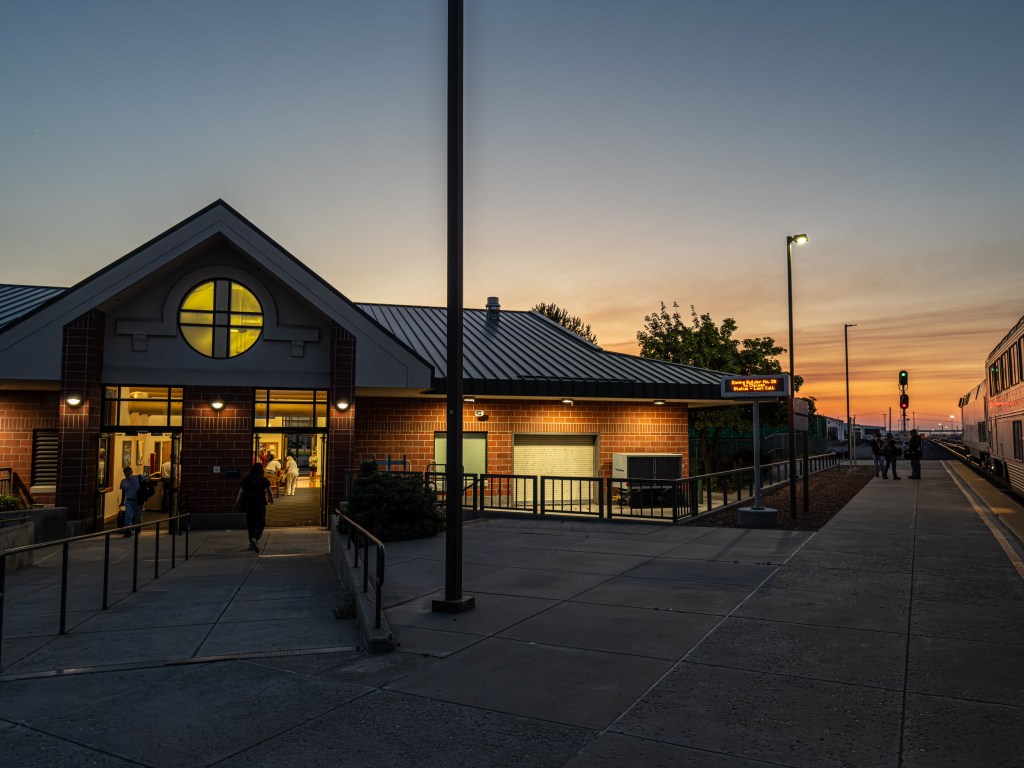
After that, the trip shifted back into travel mode.
Leaving Portland felt different from arriving. When I arrived, Hillsboro was still ahead of me. The series was still a question. I was still trying to find out what this stop would become. By the time I left, the answer was already there.
The Portland part of the project had happened.
Now the route was turning back east.
Somewhere between Montana and North Dakota, the train ride started to feel like the space between chapters. Portland was behind me, but the trip was not over. The train had already picked up another delay somewhere in the middle of the night, stretching the return east by a couple more hours. At this point, delays have almost become part of the rhythm of the project — frustrating in the moment, but also fitting for a trip that has never really been clean or simple.
What made that stretch different was that the Portland reflection was already out in the world while I was still moving. The article had gone live, the story had been shared, and the boost had been approved, but I was not sitting still watching it from home. I was somewhere between stops, carrying the same gear, following the same route, and already thinking about the next assignment.
That is the strange part of this kind of work.
One chapter can be finished publicly before it feels finished personally.
There were quiet moments in that return, too.
Somewhere after Winona, I finally crashed hard enough that the next thing I really knew, the train was already around Wisconsin Dells. It was one of those strange travel naps where the body gives up before the mind realizes it. After Portland, the early start, the edits, the writing, the posting, the logistics, and the return route, I think the exhaustion finally caught up.
That is part of the story too.
Not every important moment from a trip like this happens at a ballpark. Some of them happen in the space between stops, when the camera is packed away, the train keeps moving, and the only thing left to do is let your body shut down for a little while.
Illinois became the reset point, not the finish line.
After the long ride back east, Illinois gave the trip a pause before the next leg. It was not really a full stop. It was more of a place to breathe, reorganize, charge what needed to be charged, keep the bags together, and prepare for the next move.
That part matters because this trip has never been cleanly separated into one thing at a time.
The travel, the edits, the posts, the galleries, the expenses, the rideshares, and the next schedule all keep overlapping. Even when one part is finished, the next one is already waiting.
Then the route turned toward Kansas.
The next leg started Thursday afternoon, with a very early Friday morning arrival before the I-35 Showcase in the Wichita and Andover area. That made Wichita feel different from Portland. It did not have the same long western buildup or the same emotional weight of finally reaching Oregon, but it mattered in its own way.
Wichita was the proof that the project could keep moving after the biggest chapter was already behind me.
That is harder than it sounds.
It is one thing to build toward a major destination. It is another thing to keep going after that destination is finished, when the train sleep catches up, the bags feel heavier, the edits are still there, and the next schedule does not care how much the last stop took out of you.
The I-35 Showcase became part of that test.
This part of the trip was not about writing a full breakdown of every team or every game. I do not follow the AAU side closely enough to pretend this was going to be that kind of recap, and I do not want to force details that are not ready yet. The photos from that stop still have their own place in the overall project, but this reflection is more about what it meant to keep showing up after Portland.
By the time I reached Wichita, this trip had already included Oklahoma, Chicago, Saint Paul, the Empire Builder, Portland, Hillsboro, the return east, and another overnight push toward Kansas. I was not starting fresh anymore. I was carrying the weight of everything that came before it.
But I was still there.
That matters.
Because this whole trip has never been only about one city or one series. It has been about building a larger body of work, one stop at a time, even when the timing is tight and the route is messy.
Wichita reminded me that finishing a big chapter does not mean the work slows down.
Sometimes it means you get off one train, reset for a little while, and start moving toward the next field.
Now, on my last night in Wichita, the trip is finally turning back toward home.
The bags are almost ready again. The early morning ride is coming. The last stretch back to Oklahoma is close enough to feel real. After days of stations, delays, ballparks, rideshares, edits, posts, and trying to keep everything moving, home is finally the next stop.
But even that does not feel like a clean ending.
It feels more like a checkpoint.
This trip has taken more energy than I expected. It has tested my patience, my planning, my budget, my gear, and my ability to keep adjusting when nothing lines up perfectly. But it has also given me something real: proof that this kind of coverage can grow, proof that the work can travel, and proof that the story does not end when one gallery is finished.
Portland showed me how big this project could feel.
Wichita reminded me that the work still has to keep moving after the big moments are over.
That may be the clearest lesson from this second part of the journey.
The games end.
The travel starts again.
The bags get packed one more time.
And somehow, I am still doing it.
Part One of the reflection, “The Road to Portland,” can be read here:
 The OKPreps Rundown
Leave a comment